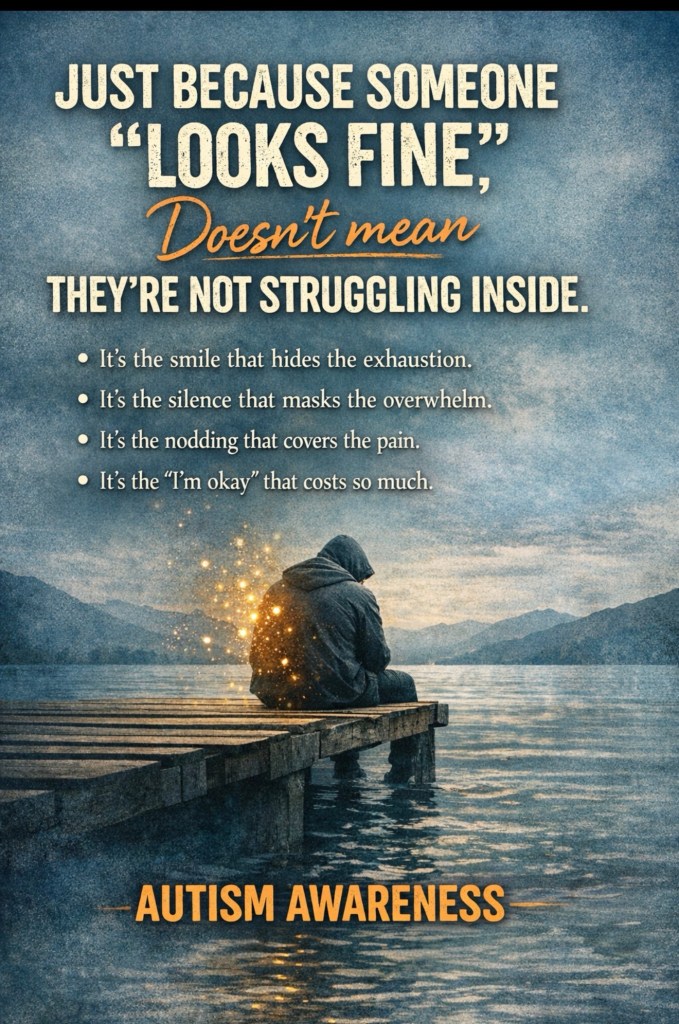
April is Autism Awareness Month.
And every year around this time, you see the same kind of things shared over and over again — puzzle pieces, slogans, awareness posts, people saying “be kind,” schools doing themed days, and social media trying to remind everyone that autism exists.
And while I understand the intent behind that, I think we need to be honest:
A lot of people are aware of autism, but they still do not understand it.
They know the word.
They know a few stereotypes.
They may know a child who is autistic.
They may know someone who is sensitive to noise or struggles socially.
They may know autism is “on a spectrum.”
But that is not the same thing as truly understanding what many autistic people carry every single day — especially the things nobody sees.
Because one of the hardest parts about autism is that many of us get really, really good at hiding the struggle.
People see you show up.
They see you do your job.
They see you answer questions.
They see you make it through a conversation.
They see you hold it together in public.
They see you stay polite.
They see you smile.
They see you function.
And because they see that version of you, they assume that version is the whole story.
But it is not.
What they do not see is the mental strain before the interaction even starts.
They do not see the rehearsing.
They do not see the overthinking.
They do not see the self-monitoring.
They do not see the constant awareness of tone, facial expression, body language, eye contact, timing, wording, and whether you are coming across “the right way.”
They do not see the pressure of trying to fit into an environment that often feels loud, tense, confusing, critical, or emotionally unsafe.
They do not see the shutdown that can happen later.
They do not see the crash after you get home.
They do not see the way your mind replays what happened.
They do not see the emotional hangover after a hard day of trying to hold everything together.
That is part of why I think autism awareness needs to go a lot deeper than what it usually does.
Because for a lot of autistic people, the struggle is not always obvious.
Sometimes the struggle is invisible because the person has spent years learning how to survive by hiding it.
The part people miss: masking
One of the biggest things people still do not understand about autism is something called masking.
Masking is when an autistic person hides, suppresses, edits, or performs over their natural traits in order to blend in, avoid judgment, reduce conflict, or simply get through the day without being singled out.
Sometimes it is intentional.
Sometimes it becomes so automatic that you do not even realize you are doing it anymore.
You just know life feels exhausting.
Masking can look like forcing eye contact when it does not feel natural.
It can look like studying other people’s reactions so you know how to respond.
It can look like rehearsing conversations before they happen and replaying them afterward.
It can look like hiding sensory overwhelm.
It can look like suppressing stimming.
It can look like pretending you understand social rules you are actually still trying to decode in real time.
It can look like acting “fine” when inside you are overloaded.
It can look like trying to always appear calm, agreeable, respectful, or easygoing because you know how quickly people can label you if you do not.
A lot of people think masking means being fake.
It does not.
Most of the time, masking is survival.
It is what happens when you learn, directly or indirectly, that the real you is more likely to be misunderstood than accepted.
So you adapt.
You study.
You perform.
You suppress.
You adjust.
And eventually, you may get so good at it that other people assume you are doing well.
Meanwhile, inside, you are exhausted.
That is the cruel part.
The more invisible your struggle becomes, the easier it is for people to dismiss it.
“But you seem fine”
That phrase right there has probably done more damage to a lot of autistic people than most people realize.
“But you seem fine.”
That statement usually means:
I am judging your internal state only by what I can see externally.
And that is a dangerous way to view people.
Because looking fine is not the same as being fine.
Someone can go to work and not be fine.
Someone can answer questions and not be fine.
Someone can stay polite and not be fine.
Someone can smile in public and not be fine.
Someone can get through a meeting, a shift, a church service, or a family event and still not be fine.
Some people have learned how to function while suffering.
That does not mean the suffering is not real.
That is why I think we need to stop measuring struggle only by visible collapse.
Not every autistic person falls apart in front of people.
A lot of autistic people hold it together in public and fall apart later in private.
And that private crash is real.
The exhaustion is real.
The irritability is real.
The numbness is real.
The shutdown is real.
The overthinking is real.
The need to isolate after too much input is real.
The sense of being emotionally drained by what others might call “normal life” is real.
Just because someone can perform wellness does not mean they are not drowning underneath it.
Autism and burnout: when your system hits a wall
I think one of the biggest things missing from public conversations about autism is autistic burnout.
Not just stress.
Not just tiredness.
Not just “having a rough week.”
Burnout is what happens when your mind, body, and nervous system have been under too much pressure for too long.
Too much masking.
Too much sensory overload.
Too much people-pleasing.
Too much conflict.
Too much criticism.
Too much unpredictability.
Too much pressure to stay calm while your insides are screaming.
Too much forcing.
Too much survival.
And eventually, the system starts breaking down.
Things that used to feel manageable now feel overwhelming.
Your patience gets shorter.
Your tolerance drops.
Noise feels louder.
Demands feel heavier.
People feel harder.
You start dreading things you used to push through.
Simple tasks feel bigger than they should.
You come home with nothing left.
Or maybe you do not even make it that far before you feel the edge of shutdown, panic, or total emotional fatigue.
From the outside, people may misread burnout.
They may call it attitude.
They may call it oversensitivity.
They may call it negativity.
They may call it not coping well.
They may say you need thicker skin or need to learn how to let things go.
But sometimes the issue is not that a person is weak.
Sometimes the issue is that they have been strong for too long in environments that keep taking from them.
That is different.
And people need to understand that.
The workplace can make autism worse, not because the person is broken, but because the environment is
This matters a lot to me, because too many people act like if someone is struggling at work, the answer must automatically be that the person just needs to toughen up, get over it, or handle things better.
But not every environment is healthy.
Some workplaces are built on tension.
Some are built on fear.
Some are built on blame.
Some are built on inconsistency.
Some are built on poor communication.
Some are built on discipline before understanding.
Some are built in ways that keep people emotionally on edge all the time.
And when you are autistic, that kind of environment can hit even harder.
Not because autistic people cannot work.
Not because autistic people are incapable.
Not because autistic people are weak.
But because an unhealthy environment puts extra strain on a nervous system that may already be working harder than most people realize.
If you are constantly trying to read people, trying to avoid conflict, trying not to say the wrong thing, trying not to be misunderstood, trying to manage tone, facial expressions, reactions, sensory input, and social pressure all at once, that is not small.
That is real labor.
And if you add criticism, write-ups, public correction, blame culture, or leadership that does not know how to create trust, the cost goes up even more.
Then people wonder why someone is shutting down.
Why someone is emotionally drained.
Why someone dreads going into work.
Why someone starts losing interest in a place they used to care about.
Why someone begins to resent an environment they once tried hard to support.
That is not always just a bad attitude.
Sometimes that is burnout.
Sometimes that is what happens when someone’s system has had enough.
A lot of autistic adults were taught to override themselves
This is another part that hits deep.
A lot of autistic adults did not just learn to mask socially.
They learned to distrust themselves.
They learned to override discomfort.
Override overwhelm.
Override confusion.
Override fatigue.
Override boundaries.
Override sensory distress.
Override emotional warning signs.
Why?
Because a lot of us were taught, one way or another, that our natural reactions were wrong.
Too sensitive.
Too emotional.
Too quiet.
Too intense.
Too awkward.
Too dramatic.
Too difficult.
Too rigid.
Too much.
So instead of asking, “What is happening inside me?”
a lot of people learned to ask, “How do I look okay right now?”
That is survival.
But it is also dangerous long term.
Because when you spend years overriding yourself, you can lose touch with what you actually need.
You might not realize how overloaded you are until you explode or shut down.
You might not realize how unsafe an environment feels until you start dreading it every day.
You might not realize how exhausted you are until your body and mind stop cooperating with the performance you used to maintain.
That is why so many autistic adults hit a point where everything catches up at once.
Not because they suddenly became weak.
But because they have been overriding real needs for too long.
The church background piece matters too
I also think this is important to say, because for some people, especially those raised in strict or performance-heavy religious environments, autism and masking can get even more tangled.
When someone grows up in religious spaces that emphasize obedience, conformity, self-denial, emotional performance, and suppressing discomfort, it can train them even more deeply to ignore themselves.
To stay quiet.
To stay agreeable.
To not question.
To not rock the boat.
To smile through pain.
To call burnout “lack of faith.”
To call boundaries selfish.
To call people-pleasing holiness.
To call silence maturity.
That can do damage.
Especially for an autistic person who is already working hard to fit in and avoid being misunderstood.
Now they are not just masking socially.
They are masking spiritually too.
They are trying to appear okay.
Trying to appear faithful.
Trying to appear respectful.
Trying to appear emotionally in line with the room.
Trying not to be “too much.”
Trying not to seem off.
Trying not to fail the expectations placed on them.
And over time, that can deeply disconnect a person from their own mind, body, and needs.
So when people talk about autism, they need to realize this stuff is not just medical or behavioral.
It touches identity.
It touches trauma.
It touches self-worth.
It touches how a person learned to survive.
Late diagnosis can feel like relief and grief at the same time
I think this is one of the most emotional parts for many adults.
When someone finds out later in life that they are autistic, it can explain so much.
But it can also hurt.
There is relief in finally having language.
Relief in realizing maybe you were not broken.
Maybe you were not failing.
Maybe you were not just bad at life.
Maybe there was a reason things felt harder than other people seemed to admit.
But there is grief too.
Grief for the years spent blaming yourself.
Grief for the times you were misunderstood.
Grief for the environments that punished what should have been understood.
Grief for how much energy went into trying to be acceptable.
Grief for how long you lived disconnected from your own needs.
Grief for the younger version of you who thought being yourself was the problem.
That grief is real.
And I think people need to make room for it.
Because awareness is not just saying “autism exists.”
Awareness should also mean understanding what it costs people when autism goes unseen, unsupported, or misunderstood for years.
Home does not always feel restful when burnout is already high
People sometimes assume home solves everything.
But if someone is already running on empty, home may not feel like instant peace.
Even people who deeply love their spouse, their kids, and their home life can still feel like they have nothing left after a hard day.
That is not a lack of love.
It is depletion.
When someone spends all day masking, navigating tension, handling sensory input, managing social pressure, and trying to stay regulated, they may come home completely spent.
And then comes the guilt.
Guilt for needing quiet.
Guilt for being short.
Guilt for not having patience.
Guilt for withdrawing.
Guilt for needing space.
Guilt for feeling touched out, talked out, and emotionally maxed out.
That is why understanding burnout matters so much.
Because a person can love their family deeply and still be near their limit.
And that does not make them selfish.
It means their system needs recovery.
Awareness should lead to understanding, not pity
This is a big one for me.
Autistic people do not need pity.
They do not need to be treated like projects.
They do not need empty slogans.
They do not need one month of shallow recognition followed by eleven months of misunderstanding.
They need respect.
They need space to be honest.
They need support that actually understands invisible effort.
They need environments that are healthier.
They need people to stop confusing external composure with internal wellness.
They need leadership that knows the difference between discipline and understanding.
They need families, schools, churches, and workplaces that are willing to learn instead of just label.
Autism awareness should not be about making everyone else feel good because they posted something supportive online.
It should be about listening more carefully to what autistic people are actually saying.
And sometimes what autistic people are saying is:
I am tired.
I am overloaded.
I am trying.
I am masking more than you know.
I am carrying more than I show.
I do not need judgment.
I need understanding.
What I wish more people understood
I wish more people understood that some autistic people are not difficult — they are overwhelmed.
I wish more people understood that not every struggle is visible.
I wish more people understood that someone can look calm and still be in survival mode.
I wish more people understood that constant criticism, tension, unpredictability, or blame can hit autistic people in a deeper way because the nervous system is already carrying more than most people realize.
I wish more people understood that masking is exhausting.
I wish more people understood that burnout is not laziness.
I wish more people understood that some people are not failing because they are weak.
They are wearing down because the cost of surviving certain environments is too high.
I wish more people understood that autism is not always loud or obvious.
Sometimes autism looks like the person who says very little, works hard, tries to stay out of the way, goes home drained, replays everything, and keeps wondering why normal life feels so much heavier than it seems to for everyone else.
And I wish more people understood that being misunderstood over and over again leaves marks.
What April should really mean
If April is going to matter, it should mean more than awareness.
It should mean more listening.
More humility.
More compassion.
More education.
More reflection on how we treat people.
More willingness to rethink environments that are harming people.
More honesty about invisible struggles.
More understanding of masking.
More understanding of burnout.
More understanding that not all disability looks the way people expect it to.
It should mean we stop asking only whether autistic people can fit the environment.
And start asking whether the environment is doing harm.
That question changes everything.
Because too many autistic people have spent years believing they were the problem when in reality they were trying to survive systems, workplaces, churches, families, and cultures that made very little room for difference.
And then they got blamed when the cost finally showed.
Final thought
Some of the strongest people you will ever meet are people who have spent years carrying invisible weight while still trying to stay kind, responsible, functional, and composed.
That is why autism awareness matters.
Not because autism is new.
Not because people have never heard the word.
But because there are still far too many people who do not understand the hidden cost of what autistic people go through just to make it through ordinary life.
This April, go deeper than awareness.
Try to understand the smile that cost someone energy.
Try to understand the silence that may be masking.
Try to understand the shutdown that is not defiance.
Try to understand the irritability that may be burnout.
Try to understand that some people “look fine” because they have spent years learning how to hide the struggle.
And maybe most of all, understand this:
Just because someone learned how to carry it quietly does not mean it is not heavy.
 Agape Freedom Sports LLC
Leave a comment